


When SpaceX’s Falcon 9 launched Thursday evening, July 14, the rocket carried with it muscle cells from Central Floridians to the International Space Station.
The cargo is an experiment run by a team of scientists from the University of Florida and AdventHealth to examine how microgravity changes muscle cells. The findings could one day prove helpful to astronauts who spend long periods in space or – for those of us who are Earthbound – potentially translate to new ways to prevent or reverse weakness developed by patients confined to bed or with limited mobility.
“This is a really exciting time for us,” said Paul Coen, PhD, an associate investigator at AdventHealth’s Translational Research Institute. “The tissue chips are like miniature labs that will allow us to study how microgravity not only negatively impacts muscle biology but will also give us the opportunity to test therapeutic countermeasures.”

Muscles atrophy and weaken when a patient is unable to move, and Dr. Coen, who studies how aging impacts muscle loss, is looking for clues to help people remain stronger for longer periods of time. The cells headed to ISS are divided into two groups – those collected from young and older adults. Scientists want to understand how microgravity might impact muscle from older adults differently from younger adults.
The shoebox-size LabCube that contains the muscle tissue chips will then be frozen and preserved before it returns to Earth later in the year. The tissue chips will travel to the University of Florida, where Siobhan Malany, MD, the lead investigator and a professor in the College of Pharmacy, will run a number of tests to determine the impact of microgravity on the cells.
This is the second launch of human muscle cells collected at AdventHealth into space after the first batch took off in 2018. New this time: electrical stimulation built into the tissue chips so that researchers can simulate the muscle cells contracting aboard ISS. The goal is to understand how contraction might protect the cells from microgravity.
A separate, but scientifically related, National Institutes of Health-funded study led by Dr. Coen is also underway at AdventHealth Translational Research Institute. He is asking participants to spend 10 days on bedrest at TRI’s Clinical Research Unit and is comparing muscle mass, fitness and other health variables before, during and after the 10-day period. People taking part in the study can’t get up and walk around, but they can read, scroll their phones or watch TV or movies.
“The bedrooms at our clinical research unit are nicely furnished and are really comfortable,” Coen said. “Generally, our participants have a pretty good time during their 10-day stay with us.”
People interested in participating in the study can find more information here.
The results from both the space and bedrest research might one day help people recover faster after long hospital stays or, perhaps one day, combat natural muscle changes brought on by aging.
12 items. To interact with these items, press Control-Option-Shift-Right Arrow. These items are in a slider. To advance slider forward, press Shift-Command-Right Arrow. To advance slider backward, press Shift-Command-Left Arrow.







News
A simple scan saved one local man’s life
Early detection across the AdventHealth East Florida Division is helping more patients find lung cancer sooner — and live longer.
Media Coverage
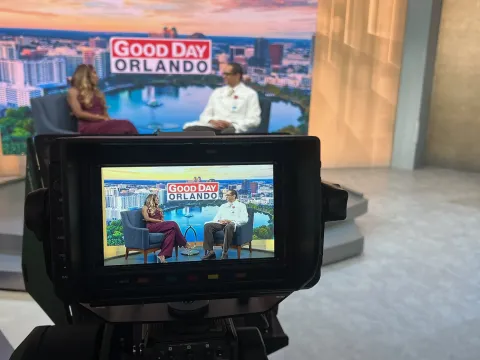
Robotic surgery in the spotlight
Dr. Abubaker Ali joined FOX 35’s HouseCalls to share how robotic surgery is transforming care for patients across Flagler, Volusia and Lake counties. He highlighted how this technology supports...
News
A new option for hope: Daytona Beach team performs groundbreaking heart procedure
Innovative technique expands life-saving options for patients once considered inoperable.
News
Easing the winter blues: Experts share how to restore wholeness to body, mind and spirit
Connection, movement, light therapy and mindful care can help lift your mood and bring balance back during the darker winter months.
News
Three local women honored for turning cancer journeys into community healing
The AdventHealth Palm Coast Foundation has named Carla Cline, Nancy Katz-Arceo and Muffy Runnells its 2025 Humanitarians of the Year.
News
New heart procedure helps Lake County residents lower stroke risk
Minimally invasive WATCHMAN FLX Pro procedure offers patients a safer, local option for stroke prevention.
News
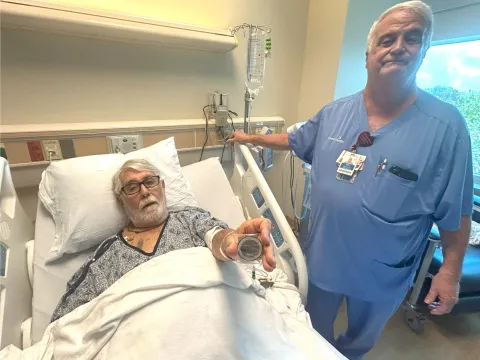
How one caregiver’s simple coin for veterans became a symbol of healing
At AdventHealth Waterman, the small gift honors veterans year-round and turns care into tribute, inviting stories to surface.
News
Q&A: How AdventHealth is redefining nurse growth through whole-person care
AdventHealth’s model for nursing career growth prioritizes nurses’ whole health to support their care for the body, mind and spirit.
News
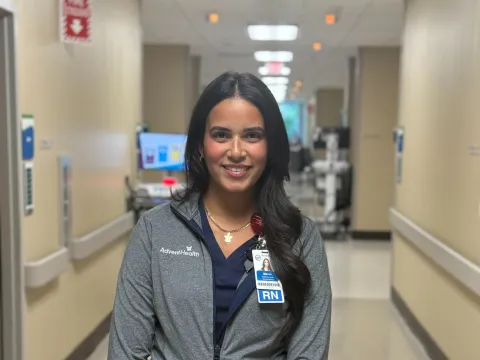
From Matanzas High School to modern medicine
When Bianca Iglesias decided to become a nurse practitioner, her goal was simple: to care for people the way she saw her grandfather cared for during his final days.
Media Coverage
Doctors agree: There's no quick fix for a cold, but these tips can make it more bearable
Waking up with a cold isn’t anyone’s idea of a good time.
News
Routine test leads Palm Coast man to lifesaving robotic surgery
What started as a routine at-home screening turned into a life-changing experience for Doug Fritz of Palm Coast, one that reminded him of the power of modern medicine and the compassion behind it.
Media Coverage
AI will push health care toward 'segments of one,' AdventHealth exec says
AI could transform healthcare personalization -- moving from broad population segments to individualized "segments of one."