

Treatment for BPH With Minimally Invasive Aquablation
Benign prostatic hyperplasia (BPH), also known as enlarged prostate, can cause symptoms that disrupt your life. At AdventHealth Wesley Chapel, we offer Aquablation therapy, an advanced, minimally invasive treatment for BPH that helps men regain comfort, retain function and get back to feeling whole.
We’re here to help you find a specialist who can determine if an Aquablation procedure is right for you.
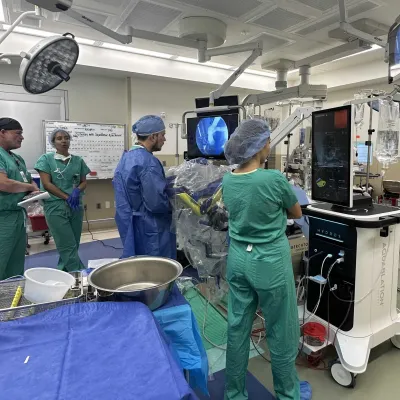
Delivering the Next Generation of Aquablation Therapy
At AdventHealth Wesley Chapel, we’re leading the way to better outcomes for treating BPH by becoming the first hospital in Wesley Chapel to use the HYDROS™ Robotic System. This next-generation AI-powered robotic system is clinically proven to provide significant, long-lasting BPH symptom relief.
State-of-the-Art BPH Treatment
In the past, choosing a treatment for BPH meant compromising recovery time, treatment effectiveness or sexual function. Aquablation therapy is a one-of-a-kind procedure that is highly targeted and minimizes risks so you can feel confident in your treatment.
-
Q:Question: What are the symptoms of BPH?
A:Answer:BPH occurs when prostate tissue continues to grow larger than normal. It’s a benign (non-cancerous) condition, but it can still cause symptoms. Symptoms of BPH include:
- A sudden, uncontrollable urge to urinate
- Decreased strength of urine stream, or weak flow
- Difficulty starting a urine stream
- Dribbling after urination
- Feeling pain during urination
- Feeling that the bladder is not completely empty
- Frequent urination
- Having the urge to urinate again, soon after finishing
- Waking at night to urinate
Continue ReadingCollapse AnswerTo rule out other conditions, your doctor may perform a physical exam and further testing, like bloodwork and imaging.
-
Q:Question: What is Aquablation therapy?
A:Answer:Aquablation therapy is a minimally invasive treatment that uses imaging, robotics and a heat-free waterjet to provide long-lasting BPH relief, no matter how large your prostate is. The procedure uses high-pressure saline to remove excess prostate tissue, relieving the pressure that the prostate places on the urethra and possibly the bladder.
-
Q:Question: Is Aquablation surgery?
A:Answer:Aquablation therapy removes prostate tissue through the urethra with no abdominal incision. This robotic technology ensures the prostate tissue is removed precisely, consistently and predictably.
Aquablation therapy typically takes less than an hour and is performed under anesthesia in a hospital, followed by an overnight stay.
-
Q:Question: What are the side effects of Aquablation?
A:Answer:We know that the primary reason men are delaying surgery is because they’re concerned about side effects. In fact, a recent survey shows that 85% of men are concerned that surgery will cause incontinence,* and 4 out of 5 men are concerned that surgery will have a permanent impact on their sexual function.**
In clinical studies, men who had Aquablation therapy had a very low rate of irreversible complications (incontinence, ejaculatory dysfunction, erectile dysfunction).
Continue ReadingCollapse Answer*Reference: Data on file at Procept Bio-Robotics
**Reference: Data from a global survey of 300 patients with BPH. Data on file at PROCEPT BioRobotics.

Urology Experts Dedicated to You
Our team of experienced urologists understands the toll an enlarged prostate can take on your whole health. We’ll ensure you feel heard, help you understand your treatment options and get you on the right path forward.
Helping You Find Lasting Relief
Reach out today to get started on the road to better health — and get relief from the symptoms that are holding you back. Our urology specialists will help you determine whether you’re a good candidate for minimally invasive Aquablation to treat your BPH.