

Many people struggle with knowing how much to eat to maintain a healthy weight and a strong heart. While the terms portion size and serving size are often used interchangeably, they have distinct differences. Keep reading to learn more about how to manage your health and your weight through how much you eat based on your body’s needs.
What Is Portion Size?
Portion size is the amount of food you choose to put on your plate and what you actually consume. Portion sizes of food prepared outside the home (such as at restaurants) has significantly increased over the years and exceed federal guidance for dietary guidance and food labels. Additionally, eating food out at a restaurant or ordering it for takeout or delivery has become increasingly popular, contributing to the rising rates of obesity.
Because larger portion sizes often lead to an excess of calories eaten, consider what’s on your plate to help manage your intake.
What Is a Serving Size?
Serving size is the amount of a specific food or drink that people typically consume. Serving sizes are set by the Food and Drug Administration (FDA) found at the top of the Nutrition Fact labels on packaged food and drink to help consumers make informed choices. The serving size is shown as a common household measure appropriate for that food.
How to Calculate Portion Size
Measuring cups and spoons are great tools for matching your portion to the serving size, but they’re not always available it’s time to eat. Another way to calculate your portion is by comparing it to something else of a similar size.
- A baseball or an average-sized fist
- Measures about 1 cup
- An appropriate portion size for raw or cooked vegetables, whole fruit or 100% fruit juice
- A tennis ball or small, scooped handful
- Measures about ½ cup
- Equal to 1-ounce equivalent for grains, such as pasta, rice and oatmeal
- A deck of cards or the palm of the hand
- Measures about 3 ounce-equivalents
- An appropriate portion size for fish, chicken, beef and other meats
- The size of the thumb
- Measures about 1 tablespoon
- An appropriate portion size for peanut butter or other nut spreads such as almond butter
- A postage stamp or the tip of the pointer finger to the first joint
- Measures about 1 teaspoon
- An appropriate portion size for oils or other fats
Measure your foods often to get an idea of what the serving sizes look like. It gets easier to pick the appropriate amount over time and with practice. While serving sizes are a valuable tool, it's important to look for cues from your body while you’re eating. If you’re still hungry after eating one serving, that likely means you need more food. And if you're full after less than one full serving, that's OK, too. We’re all made differently.
How to Read a Nutrition Label
According to the American Heart Association, the Nutrition Facts label can help you make healthier eating choices and identify nutrient-dense foods for a healthy diet:
- Start with the serving information.
This tells the size of a single serving and the total number of servings per container. The serving size reflects the amount people typically eat or drink.
- Check total calories per serving and container.
Notice how many calories are contained in one serving. Compare this to the number of servings you eat. If you eat two servings, you double the calories and nutrients.
The next sections on a Nutrition Facts label are about the amounts of specific nutrients in the product.
- Limit certain nutrients.
Check key nutrients and understand what you’re looking for.
- Focus on the amount of saturated and trans fats rather than the amount of total fats. Not all fats are bad.
- Avoid trans fat. When the Nutrition Facts label lists “0 g” of trans fat but includes “partially hydrogenated oil” in the ingredient list, it means the food contains some trans fat, but less than 0.5 grams per serving. So, if you eat more than one serving, you could end up eating too much trans fat.
- Total sugars can include both natural and added sugars.
- Limit the amounts of added sugars, saturated fat and sodium you eat.
- Compare labels on different brands or similar products and choose foods with less of these nutrients when possible.
- Get enough of the beneficial nutrients.
Make sure you get enough of the nutrients your body needs, such as calcium, dietary fiber, iron, potassium and vitamin D.*
We all need more dietary fiber to help reduce blood cholesterol levels, provide us with a feeling of fullness and manage a healthy body weight. Adults need at least 25-35 grams of fiber daily for good health.
- Understand % Daily Value.
The % Daily Value (DV) tells you the percentage of each nutrient in a single serving, in terms of the daily recommended amount. If you want to consume less of a nutrient (such as saturated fat or sodium), choose foods with a lower % DV (5% or less). If you want to consume more of a nutrient (such as fiber), choose foods with a higher % DV (20% or more).
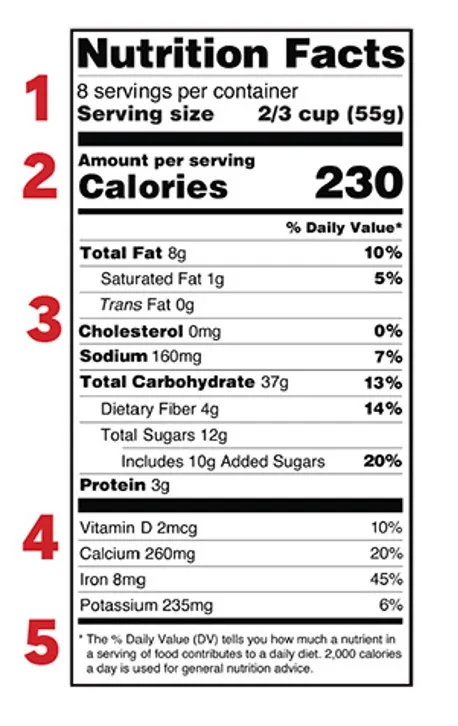
The information shown on the label is based on a diet of 2,000 calories a day. You may need less or more than 2,000 calories depending upon your age, gender, activity level and whether you’re trying to lose, gain or maintain your weight.
The U.S. Food and Drug Administration (FDA) regulates the Nutrition Facts label on packaged foods and drinks. In 2016, the FDA released changes to the label to make it easier to see how many calories and added sugars are in a product and to make serving sizes more realistic. As of January 2020, all food manufacturers were required to make these changes on the Nutrition Facts labels on their products.
Use Portion Control for Weight Loss
It's easy to mistake a larger portion as a better value. To overcome portion distortion and downsize your helpings, try the following:
- Read the label: In addition to other important information, the Nutrition Facts label can help you to identify the appropriate serving size.
- Eat from a plate: It's easy to eat more than one serving when eating straight from the package. Portion out your food first and put the container away before you start munching to keep your portion size in check.
- Use the right tools: Try portioning out foods with measuring cups and spoons to give yourself an idea of what the serving size looks like. Small plates and bowls can also make the portion sizes appear larger and leave you feeling more satisfied.
- Skip portion upgrades: When dining out, it can seem like a better value to pay 50 cents extra for a larger size. If you can safely transport the food home to eat later, that might be a good deal. Otherwise, just stick to the serving size you know you can eat at one sitting without feeling too full.
Effective Weight-Loss Solutions for a Lifetime of Health
We know how frustrating trying to reach a weight-loss goal can be and how disappointing some weight-loss programs can feel. At AdventHealth, you’ll have a team of world-class physicians, nutritionists, psychologists and other experts dedicated to helping you reach and maintain your healthiest weight.
Our surgical and nonsurgical weight-loss solutions address the needs of your body, mind and spirit. Our experts will craft a comprehensive weight-loss treatment plan that works for you now and for the rest of your life.
Visit us here to learn more or find a doctor. You deserve to feel whole.
5 items. To interact with these items, press Control-Option-Shift-Right Arrow.