
Medical Director, Global Robotics Institute and
Urologic Oncology Program
AdventHealth Celebration
This Clinician's View is written by Vipul Patel, MD, Medical Director of the Global Robotics Institute at AdventHealth Celebration and Medical Director of the AdventHealth Cancer Institute Urologic Oncology Program.
In 2001, from an operating room in New York City, French surgeon Jacques Marescaux, MD, FACS, used robotic surgical instruments and high-speed telecommunications to successfully perform a gallbladder removal on a patient who was in Strasbourg, France, over 6,000 kilometers away. Known as the Lindbergh operation, this major medical milestone highlighted the potential for telesurgery to revolutionize surgical care delivery. Unfortunately, technological challenges and economic constraints stymied its widespread adoption.
Now, nearly 25 years later, advances in robotic-assisted technology and high-speed international internet connection are starting to open new doors. After two years of diligent research and careful preparation, our AdventHealth surgical team took a giant leap forward on June 14, 2025, performing the longest distance telesurgery ever completed. While at the AdventHealth Nicholson Center in Celebration, Florida, I successfully performed a robotic prostatectomy on a 67-year-old patient with prostate cancer who was nearly 7,000 miles away in Luanda, Angola. This achievement was of huge humanitarian importance and part of my mission to expand access to specialized surgical care for underserved populations in remote and rural locations throughout the world.
Addressing Global Health Care Inequity Through Telesurgery
People in many parts of the world, including rural areas across the U.S., are plagued by limited or no access to surgical treatment options. In fact, the World Health Organization has stated that while over 300 million surgeries are performed annually, an additional 143 million are required to save lives and prevent disability. This lack of or delay in appropriate surgical treatment can negatively impact patient mortality, disability and quality of life, especially for neurovascular, cardiac and oncological diseases. I believe telesurgery holds the power to help bridge this gap.
Traditionally, access to surgery, especially high-end surgery, has been restricted to areas with higher levels of wealth and education. The technology was expensive, and even if it could be secured, communities lacked physicians with the ability to operate it because surgical training was limited by geographical proximity and the availability of experienced mentors.
Fortunately, conditions are finally aligning to make telesurgery a more feasible solution. The cost of surgical robotic platforms is decreasing as more systems come onto the market, and the security, availability and reach of high-speed telecommunications networks is increasing. Furthermore, telesurgery by its very nature, enables remote education and training – something we do almost every day at the AdventHealth Global Robotics Institute in Celebration, Florida. Our approach allows expert surgeons to mentor and guide trainees in real-time across vast distances, creating new collaborative opportunities and fostering a global community of surgical practices.
Forging New Frontiers – AdventHealth’s Telesurgery Journey
About two years ago, our team identified telesurgery as a potential opportunity to take the next step in training and education. Since December 2023, we have been performing trials and remote connections with several centers worldwide:
- First, we went and spent a significant amount of time in Asia going to various hospitals to better understand how their technology was different from ours and how they were using it to potentially perform surgery remotely.
- For our second trip to Asia, our surgical team secured medical licenses to operate in China. Using new technology, we were able to perform telesurgery on patients 2,000 – 5,000 kilometers away from where we were. While we concluded this concept was very new and still needed work, our group became convinced this was the future of surgery. It held the potential to teach a surgeon from a remote distance, take care of a complication or help a patient who previously lacked access to surgical treatment.
- In early 2024, we conducted a pioneering prospective study on telesurgery in live porcine models by establishing a telerobotic connection between our facility in Orlando, Florida, and an animal laboratory in Shanghai, China, via the Pacific Ocean. Our team performed 10 radical nephrectomies and two partial nephrectomies using a robotic platform.
- Then in July 2024, we completed the first study exploring telesurgery’s teleproctoring and teaching potential while performing long-distance procedures between Orlando and Shanghai, a distance over 13,000 km, using a robotic platform and fiber-optic technology. Our team simulated a real-life scenario where surgeons in both locations took turns controlling the robotic system as we preformed urologic procedures on live porcine models.
- In September 2024, we conducted a telesurgery procedure where the live animal model was in Orlando, Florida, while the surgeon operated remotely from São Paulo, Brazil. This marked the first telesurgery robotic procedure between these two cities and opened new avenues for future studies on remote surgical connectivity inside the American continent.
All these studies and experiences helped us to hone our approach, improving both safety and efficacy.
Achieving an International Medical Milestone -- The Angola Telesurgery Case
According to the Global Cancer Observatory (GLOBOCAN), Angola faces one of the highest prostate cancer mortality rates in sub-Saharan Africa, with limited access to early detection and specialized surgical care. Several years ago, AdventHealth established a collaborative medical relationship with a hospital in Luanda to assist with surgical training and education as well as establishment of a prostate cancer screening program. That hospital went on to secure a robotic surgery platform, and when an opportunity for remote connectivity arose in October 2024, we partnered with them on a study to evaluate the feasibility of implementing remote surgical procedures. It found the robotic platform demonstrated optimal functionality with a robust connection. This led us to dream bigger.
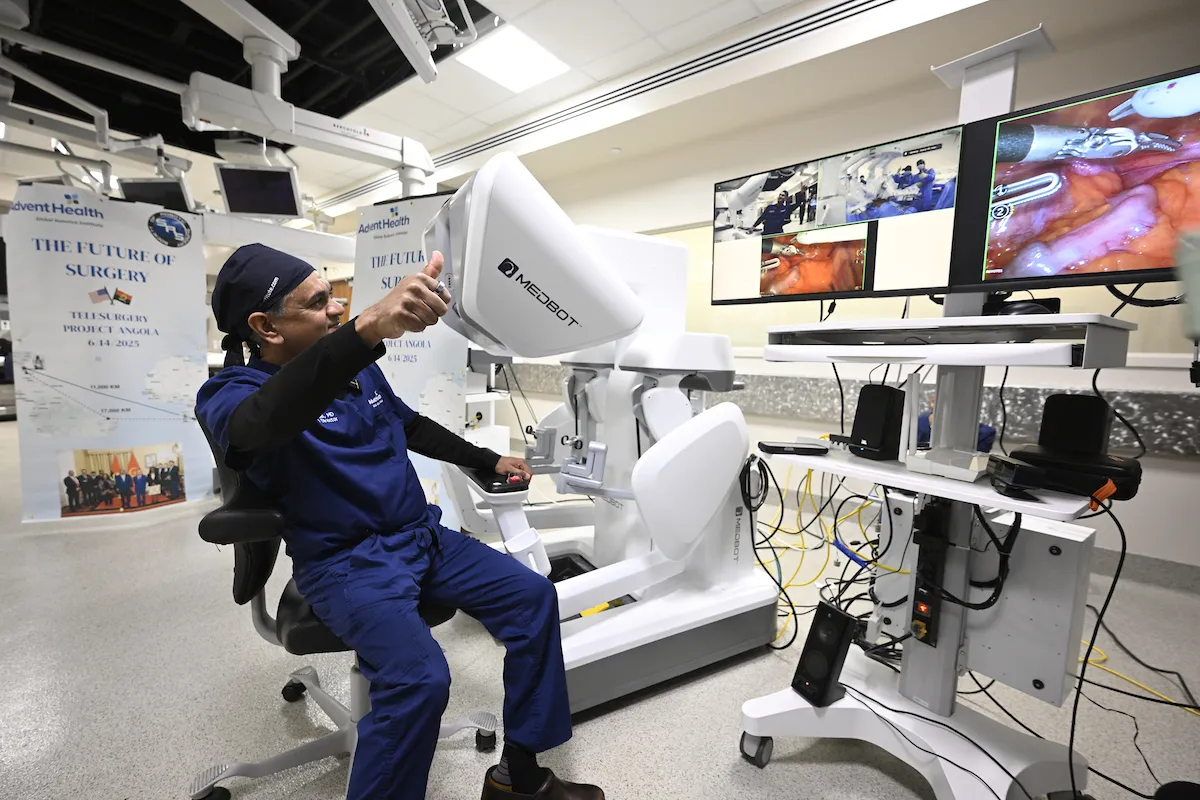
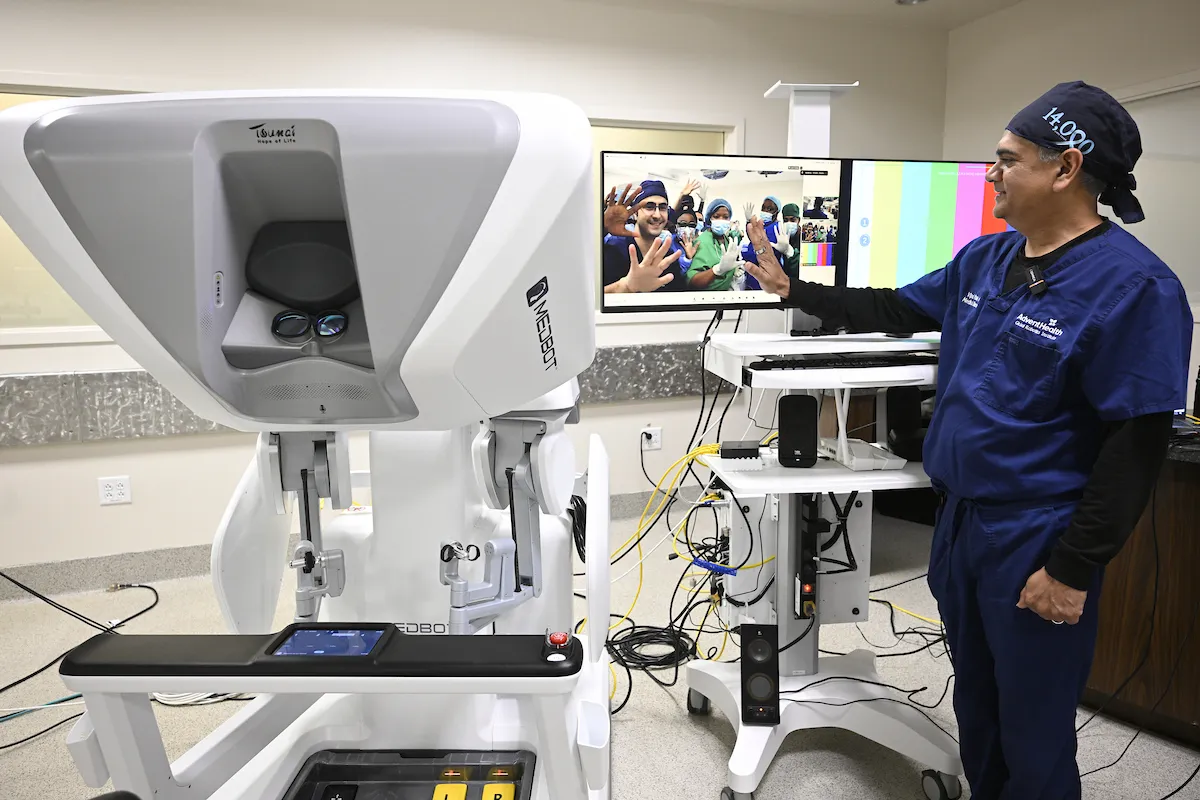
Our AdventHealth team pursued and achieved quick approval from the U.S. Food and Drug Administration (FDA) for an Investigational Device Exemption (IDE) clinical trial. It became the first human clinical trial of a transcontinental robotic telesurgery procedure initiated in the United States, and I performed the robotic prostatectomy case on June 14, 2025. We had a surgical team in the operating room in Angola to monitor for potential issues, but none arose, and the patient experienced a successful outcome. Our team will perform nine more telesurgery cases (10 total) at the same site as part of this trial and then will assess and report the data and outcomes.
Ensuring the Safety, Quality and Ethical Exploration of Telesurgery
As we continue to explore new horizons in telesurgery, our team strongly believes that standardized protocols and guidelines are essential to ensuring ethical care and patient safety. To that end, we worked with a collaborative community of stakeholder experts to develop what we currently call our “10 Commandments for Telesurgery:”
- Prioritize Patient Safety and Efficacy: Ensure that all robotic and networking systems meet the highest standards of safety and efficacy through rigorous testing, certification, and regular monitoring. Ensure that all medical staff have adequate training and certification in telesurgery.
- Maintain Transparency, Honesty & Consent: Provide clear, truthful, and accessible information about the capabilities, limitations, risks and economics associated with robotic telesurgery to patients and the public. Obtain explicit consent about the remote nature of the surgery and the teams involved.
- Foster Human Interaction and Empathy: Despite the remote delivery method of robotic telesurgery, ensure that human empathy and patient comfort are prioritized by involving compassionate medical staff in the patient care process.
- Adhere to Ethical Medical Practices: Maintain the highest standards of medical ethics, including respecting patient autonomy, doing no harm, providing the best possible care and having telesurgical approvals from national, trans-national and international regulatory bodies. Initial telesurgeries ought to be performed under an IRB/investigational protocol monitored by an administrative body.
- Establish Clear Accountability and Liability: Define and communicate the shared responsibility and liability among all parties involved in robotic telesurgery, including the local and remote surgical teams and hospitals, device manufacturers, and telecommunication providers.
- Uphold Data Privacy and Security: Implement robust cybersecurity measures and adhere to international data protection laws to safeguard sensitive patient information stored, processed and transmitted in real-time against unauthorized access and breaches.
- Promote Accessibility and Equity: Make robotic telesurgery accessible and affordable to all individuals, regardless of geographic location or socioeconomic status, to prevent healthcare disparities nationally and globally.
- Encourage International Collaboration and Standardization: Work towards harmonizing regulatory and ethical telesurgery standards across borders to facilitate international cooperation and consistency in robotic telesurgery practices.
- Promote Continuous Education and Training: Ensure ongoing professional development and training for all medical professionals involved in robotic telesurgery to keep pace with technological advancements and ethical considerations.
- Promote Innovation of Safe & Trusted Telesurgery Technologies: Ensure continuous innovation in telesurgery, robotics and connectivity technologies. Encourage the development and application of emerging technologies such as artificial intelligence and real time surgical imaging.
These serve as guideposts for AdventHealth’s ongoing telesurgery research and development efforts, and because we learn more from each experience, we are continually evaluating and refining them.
Expanding Telesurgery to Transform Global Health Outcomes and Surgical Education
While telesurgery is still in its infancy, the implications in terms of humanitarian benefit and the future of surgery are tremendous. Just as we started AdventHealth’s Global Robotics Institute with prostate cancer and urology before adding physicians and evolving into other specialties, I believe the same can be achieved with telesurgery. We must start small and refine and prove our work before carefully expanding to meet other needs, which we know are great.
Our team is already working with groups like the United Nations and the World Health Organization to share and demonstrate the benefit of telesurgery, and they’re seeing it. We also look forward to exploring its potential to improve surgical care closer to home, in rural hospitals throughout the U.S.
For me, telesurgery is more than innovation, it’s a humanitarian leap forward. In an era where technology increasingly transcends borders, we hold the power to potentially transform the way health care is delivered to remote, underserved communities that have long lacked access. I’m committed to leading this journey and can’t wait to see what we discover around the next corner.
Learn more at the Global Robotics Institute website.
5 items. To interact with these items, press Control-Option-Shift-Right Arrow.